
Mill town on the Flint River
Spray Foam Insulation in Flushing, MI
Flushing's homes are mostly owner-occupied, with a big wave from the 1960s and 1970s.
- Free on-site estimates
- Written quote listing foam type, thickness and R-value for each area
- Rim joists, attic bypasses and moisture checked before we price
Insulating Flushing Homes
Spray Foam Insulation in Flushing works on a town that is mostly owner-occupied and fairly settled. Point2Homes' census summary shows 78.4% of occupied homes are owner-occupied and only about 1.4% of homes sit vacant. The 1970s were the busiest decade, with 24.7% of homes, followed by the 1960s at 17.2%. Close to 19% of homes date to 1939 or earlier.
A mill town on the river
Flushing began as a mill town in the mid-1830s on the Flint River, the county's largest. A sawmill was running by 1837, the village was platted in 1840 and incorporated in 1877, and the railroad arrived in 1888. The oldest houses near downtown and the river are wood-frame homes from those decades, where walls are often empty and attics barely insulated.
1960s and 1970s houses
A lot of Flushing's housing is brick and frame ranches, tri-levels and colonials from the 1960s and 1970s. These usually have some attic insulation but very little air sealing, and the rim joists are typically bare or loosely stuffed. For these, the attic and rim are the first two jobs.
Near the river
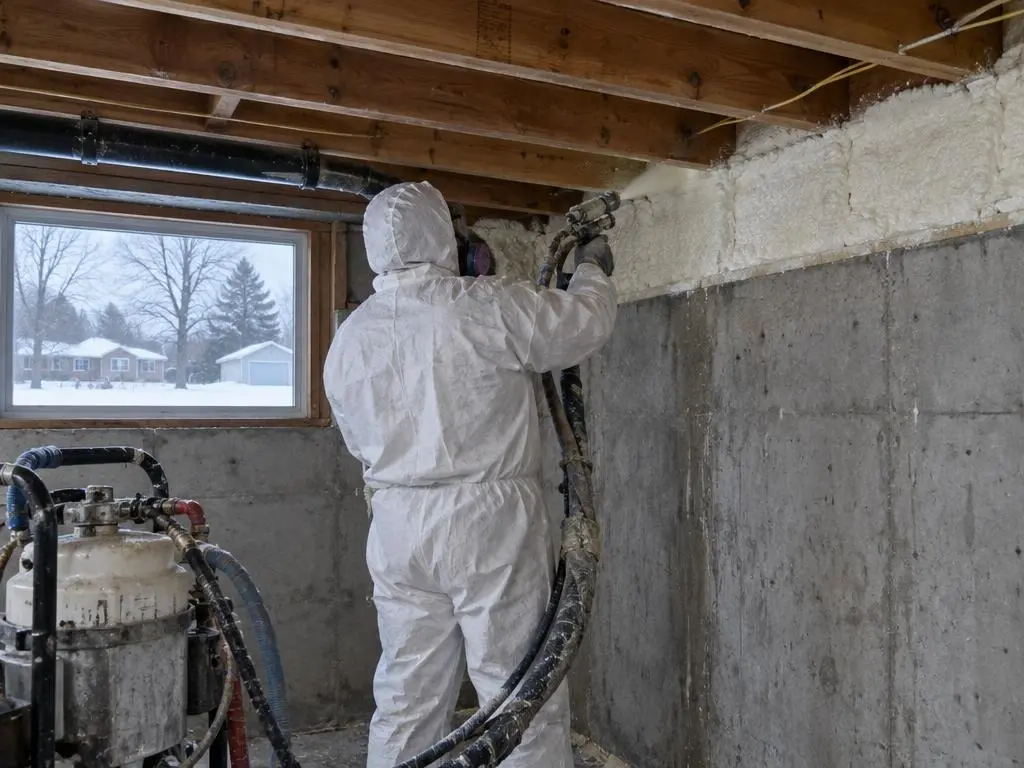
Homes on low ground by the river can have damp basements. We check for moisture before recommending any basement wall insulation, since foam should not go over a wall that is actively wet.
Old wiring
In the oldest Flushing homes, we look for knob-and-tube wiring before filling walls, since it should not be buried in insulation. An electrician can confirm whether it is still live.
Tri-levels and colonials
Flushing's 1970s tri-levels have three or four separate attic or rim areas at different heights, and colonials have a long rim joist around the whole first floor. We check every section, because the coldest room is usually over the part that got missed. Bonus rooms and family rooms over garages get extra attention, since the garage below is often unheated.
Call (810) 428-0486 or get a free estimate for a visit and written price.
Flushing Housing Facts
- 1970s peak. 24.7% of Flushing homes were built in the 1970s and 17.2% in the 1960s; 18.9% date to 1939 or earlier (Point2Homes).
- Owner-occupied. 78.4% of Flushing's 3,629 occupied homes are owner-occupied (Point2Homes).
- Mill town. Flushing's sawmill was running by 1837; the village was incorporated March 21, 1877 (Wikipedia).
- Flint River. The Flint River, Genesee County's largest, runs through Flushing (Wikipedia).
Flushing Questions
Should I insulate my basement walls if the basement gets damp?
Not until the moisture is handled. We check walls and grading first, and foam the rim joist, which is above the wet zone, in the meantime.
What do 1970s Flushing homes need most?
Usually air sealing and more depth in the attic, and closed-cell foam on the rim joist.
What if my house has knob-and-tube wiring?
We do not bury live knob-and-tube in insulation. An electrician should check or replace it first.
Why is the room over my garage cold?
Usually because the floor over the garage was poorly insulated and sealed. Foam in that floor is the common fix.
Spray Foam Insulation Near Flushing
- Spray Foam Insulation in Flint, MI
- Spray Foam Insulation in Burton, MI
- Spray Foam Insulation in Grand Blanc, MI
- Spray Foam Insulation in Flint Township, MI
- Spray Foam Insulation in Fenton, MI
- Spray Foam Insulation in Davison, MI
- Spray Foam Insulation in Swartz Creek, MI
- Spray Foam Insulation in Mount Morris, MI
- Spray Foam Insulation in Clio, MI
- Spray Foam Insulation in Montrose, MI
- Spray Foam Insulation in Linden, MI
- Spray Foam Insulation in Lapeer, MI